Thursday, July 2, 2009
The Chaser's War On Everything
source
source
A merry heart doeth good like a medicine: but a broken spirit drieth the bones.
Proverbs 17:22

Wednesday, July 1, 2009
Emmy's Music: And the Beat Goes On... or Does it?
And so it continues... here's another article about the on-going saga of whether Emmy's Spaghetti Shack can play live music or not.

Council to mull music at Emmy's
By David Bolling
INDEX-TRIBUNE EDITOR
June 29, 2009
source
Live music at Emmy's Spaghetti Shack is either the best thing to happen to Sonoma since wine, or a rude intrusion of unwanted noise in a quiet residential neighborhood.
Or both. Public opinion on the new restaurant's efforts to bring late-night live music to the old Deuce restaurant building at 691 Broadway, is divided partially along geographic and demographic lines, with 31 people, representing 24 homes and a somewhat older constituency, passionately opposed to the six-month temporary use permit for non-amplified live music approved by the Sonoma Planning Commission on May 14.
But in a packet of agenda materials running almost a half-inch thick, city staff present a profile of public opinion that tilts heavily toward approval of the use permit sought by Emmy Kaplan. Out of 86 letters included in the City Council packet, 60 favor the music permit, 26 are opposed. But the 31 people occupying the 24 homes lying in a semi-circle around the restaurant site filed an appeal of the Planning Commission's conditional approval, and Wednesday night the City Council must play Solomon without dividing the baby.
Grounds for the appeal include the following issues:
There is no objective evidence the proposed live music can be conducted in compliance with the city's noise ordinance. Because Kaplan's proposal was revised shortly before the Planning Commission's public hearing, the public did not have sufficient time to examine the revised proposal.
The revised proposal defines the permit as allowing a "restaurant with live music," rather then the original permit request for a "restaurant with nightclub/lounge." Opponents feel the original designation is more accurate and should have been retained.
The Planning Commission gave too much weight to the perceived need for an entertainment/dancing establishment instead of the impact it would have on residents in the neighborhood.
City staff recommend the council approve the permit as adopted by the Planning Commission, but outlined three other alternatives including denial of the permit, further restricting conditions of the permit, or sending the permit application back to the commission with direction to focus on specific areas of concern raised by the appellants.
While a two-to-one majority of letter writers favor the music permit, it's not clear how much influence public opinion will have over the four council members who must weigh the pro/con arguments. (Councilmember Joanne Sanders is vacationing in France and will not be present for the debate.)
The restaurant's location is in an area zoned for mixed use and if the music permit is ultimately granted it will remain with the land, not with the business, a fact that further enflames opponents' fears. Opponents also question how the proposed outdoor music nights can fail to exceed the city's noise ordinance which impose limits of 60 decibels in the daytime and 50 decibels at night.
In considering the permit application, the Planning Commission discussed the idea of hiring a noise consultant to conduct a study - at a projected cost of $2,500 to $3,000 - that would have been paid by Kaplan. That suggestion, however, was ultimately dropped.
But after consulting with the firm that prepared the city's noise ordinance, city staff concluded that live amplified music, or acoustic horn or brass music conducted outside on the patio, probably would exceed noise-ordinance limits.
The conditional use permit, therefore, was limited to live acoustic - non-amplified - music outdoors on Monday through Thursday from 11 a.m. to 8 p.m. (limited to one occurrence a week) and on Saturday and Sunday from 11 a.m. to 9 p.m. Indoor music could be played Thursday through Saturday from 11 a.m. to 1:30 a.m. Karaoke would be allowed inside only once each month.
The issue will be debated during a public hearing set to follow immediately after the consent calendar.
In other city business, the council will convene at 5 p.m. for a closed session to discuss a property negotiation, will then meet with legal counsel to discuss the lawsuit originally filed by Preston Cook's Argonaut Investments regarding the condo-conversion of Rancho de Sonoma, and will then convene a study session at 5:15 p.m. to hear a presentation from the Sonoma County Water Agency regarding the city's water supply.
The regular council meeting will begin at 6 p.m. in the Community Meeting Room at 177 First St. W.
COMMENTS:
ANIPSEOJ@ATT.NET wrote on Jun 30, 2009 12:22 PM:
" The people against had better get at many more signatures before the wed night meeting as they can or they are going to lose. "
vze3p2y5@verizon.net wrote on Jun 30, 2009 10:28 PM:
" I would hope that anyone that would be opposed to entertaining music for local citizens would even rise to the higher order of controlling the loud noises of motorcycles that are coming into this town on the weekends and scaring tourists off the streets of the plaza and intruding on the peaceful nature of our wonderful community. A Sunday morning walk on The Overlook Trail becomes destroyed by the sound of motorcycles zooming thru the plaza. Let's keep Sonoma a quiet place to enjoy. City Council, please take this up as enforceable by the Sonoma police. Otherwise we will possbly have hundreds of tourists motorcycles ZOOMING thru town every weekend. "
tambourineman2@comcast.net wrote on Jun 30, 2009 11:32 PM:
" We should ban loud trucks, loud busses, loud cars, loud airplanes from flying over, sirens, big-rigs, bands, parades, tourists, people who complain, music in general, all speech except whispers. And you already have hundreds of m'cycles cruising Sonoma all week and weekends. They have the gall to stop and buy petrol, shop at stores, eat at restaurants etc etc. Where will it end?????? "
Council to mull music at Emmy's
By David Bolling
INDEX-TRIBUNE EDITOR
June 29, 2009
source
Live music at Emmy's Spaghetti Shack is either the best thing to happen to Sonoma since wine, or a rude intrusion of unwanted noise in a quiet residential neighborhood.
Or both. Public opinion on the new restaurant's efforts to bring late-night live music to the old Deuce restaurant building at 691 Broadway, is divided partially along geographic and demographic lines, with 31 people, representing 24 homes and a somewhat older constituency, passionately opposed to the six-month temporary use permit for non-amplified live music approved by the Sonoma Planning Commission on May 14.
But in a packet of agenda materials running almost a half-inch thick, city staff present a profile of public opinion that tilts heavily toward approval of the use permit sought by Emmy Kaplan. Out of 86 letters included in the City Council packet, 60 favor the music permit, 26 are opposed. But the 31 people occupying the 24 homes lying in a semi-circle around the restaurant site filed an appeal of the Planning Commission's conditional approval, and Wednesday night the City Council must play Solomon without dividing the baby.
Grounds for the appeal include the following issues:
There is no objective evidence the proposed live music can be conducted in compliance with the city's noise ordinance. Because Kaplan's proposal was revised shortly before the Planning Commission's public hearing, the public did not have sufficient time to examine the revised proposal.
The revised proposal defines the permit as allowing a "restaurant with live music," rather then the original permit request for a "restaurant with nightclub/lounge." Opponents feel the original designation is more accurate and should have been retained.
The Planning Commission gave too much weight to the perceived need for an entertainment/dancing establishment instead of the impact it would have on residents in the neighborhood.
City staff recommend the council approve the permit as adopted by the Planning Commission, but outlined three other alternatives including denial of the permit, further restricting conditions of the permit, or sending the permit application back to the commission with direction to focus on specific areas of concern raised by the appellants.
While a two-to-one majority of letter writers favor the music permit, it's not clear how much influence public opinion will have over the four council members who must weigh the pro/con arguments. (Councilmember Joanne Sanders is vacationing in France and will not be present for the debate.)
The restaurant's location is in an area zoned for mixed use and if the music permit is ultimately granted it will remain with the land, not with the business, a fact that further enflames opponents' fears. Opponents also question how the proposed outdoor music nights can fail to exceed the city's noise ordinance which impose limits of 60 decibels in the daytime and 50 decibels at night.
In considering the permit application, the Planning Commission discussed the idea of hiring a noise consultant to conduct a study - at a projected cost of $2,500 to $3,000 - that would have been paid by Kaplan. That suggestion, however, was ultimately dropped.
But after consulting with the firm that prepared the city's noise ordinance, city staff concluded that live amplified music, or acoustic horn or brass music conducted outside on the patio, probably would exceed noise-ordinance limits.
The conditional use permit, therefore, was limited to live acoustic - non-amplified - music outdoors on Monday through Thursday from 11 a.m. to 8 p.m. (limited to one occurrence a week) and on Saturday and Sunday from 11 a.m. to 9 p.m. Indoor music could be played Thursday through Saturday from 11 a.m. to 1:30 a.m. Karaoke would be allowed inside only once each month.
The issue will be debated during a public hearing set to follow immediately after the consent calendar.
In other city business, the council will convene at 5 p.m. for a closed session to discuss a property negotiation, will then meet with legal counsel to discuss the lawsuit originally filed by Preston Cook's Argonaut Investments regarding the condo-conversion of Rancho de Sonoma, and will then convene a study session at 5:15 p.m. to hear a presentation from the Sonoma County Water Agency regarding the city's water supply.
The regular council meeting will begin at 6 p.m. in the Community Meeting Room at 177 First St. W.
COMMENTS:
ANIPSEOJ@ATT.NET wrote on Jun 30, 2009 12:22 PM:
" The people against had better get at many more signatures before the wed night meeting as they can or they are going to lose. "
vze3p2y5@verizon.net wrote on Jun 30, 2009 10:28 PM:
" I would hope that anyone that would be opposed to entertaining music for local citizens would even rise to the higher order of controlling the loud noises of motorcycles that are coming into this town on the weekends and scaring tourists off the streets of the plaza and intruding on the peaceful nature of our wonderful community. A Sunday morning walk on The Overlook Trail becomes destroyed by the sound of motorcycles zooming thru the plaza. Let's keep Sonoma a quiet place to enjoy. City Council, please take this up as enforceable by the Sonoma police. Otherwise we will possbly have hundreds of tourists motorcycles ZOOMING thru town every weekend. "
tambourineman2@comcast.net wrote on Jun 30, 2009 11:32 PM:
" We should ban loud trucks, loud busses, loud cars, loud airplanes from flying over, sirens, big-rigs, bands, parades, tourists, people who complain, music in general, all speech except whispers. And you already have hundreds of m'cycles cruising Sonoma all week and weekends. They have the gall to stop and buy petrol, shop at stores, eat at restaurants etc etc. Where will it end?????? "
Saturday, June 27, 2009
Toxic War and our Vets
This past weekend, I visited high school friends (link) and am suprised to hear of classmates who are Viet Nam vets that are still physically suffering. Agent Orange?
Here is an article that brings to light more of the tragic health problems of our vets today. And while you are looking into this subject, please google 'depleted uranium' - a real shock!
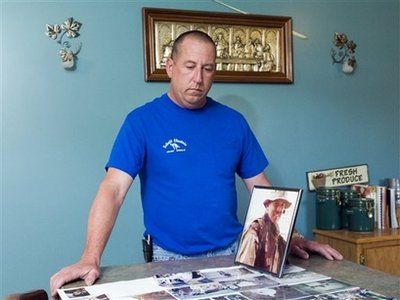
In this May 18, 2009 photo, Steve Moore recalls his brother, David, through photographs at home in Dubois, Ind. Sgt. David Moore died last year of a lung disorder after serving in the National Guard in Iraq where his brother believes he was exposed to a deadly chemical. (AP Photo/Brian Bohannon)
Did toxic chemical in Iraq cause GIs' illnesses?
By SHARON COHEN, AP National Writer Sharon Cohen, Ap National Writer
June 27, 2009
source
Larry Roberta's every breath is a painful reminder of his time in Iraq. He can't walk a block without gasping for air. His chest hurts, his migraines sometimes persist for days and he needs pills to help him sleep.
James Gentry came home with rashes, ear troubles and a shortness of breath. Later, things got much worse: He developed lung cancer, which spread to his spine, ribs and one of his thighs; he must often use a cane, and no longer rides his beloved Harley.
David Moore's postwar life turned into a harrowing medical mystery: nosebleeds and labored breathing that made it impossible to work, much less speak. His desperate search for answers ended last year when he died of lung disease at age 42.
What these three men — one sick, one dying, one dead — had in common is they were National Guard soldiers on the same stretch of wind-swept desert in Iraq during the early months of the war in 2003.
These soldiers and hundreds of other Guard members from Indiana, Oregon and West Virginia were protecting workers hired by a subsidiary of the giant contractor, KBR Inc., to rebuild an Iraqi water treatment plant. The area, as it turned out, was contaminated with hexavalent chromium, a potent, sometimes deadly chemical linked to cancer and other devastating diseases.
No one disputes that. But that's where agreement ends.
Among the issues now rippling from the courthouse to Capitol Hill are whether the chemical made people sick, when KBR knew it was there and how the company responded. But the debate is more than about this one case; it has raised broader questions about private contractors and health risks in war zones.
Questions, says Sen. Evan Bayh, who plans to hold hearings on the issues, such as these:
"How should we treat exposure to potentially hazardous chemicals as a threat to our soldiers? How seriously should that threat be taken? What is the role of private contractors? What about the potential conflict between their profit motives and taking all steps necessary to protect our soldiers?
"This case," says the Indiana Democrat, "has brought to light the need for systemic reform."
For now, dozens of National Guard veterans have sued KBR and two subsidiaries, accusing them of minimizing and concealing the chemical's dangers, then downplaying nosebleeds and breathing problems as nothing more than sand allergies or a reaction to desert air.
KBR denies any wrongdoing. In a statement, the company said it actually found the chemical at the Qarmat Ali plant, restricted access, cleaned it up and "did not knowingly harm troops."
Ten civilians hired by a KBR subsidiary made similar claims in an arbitration resolved privately in June. (The workers' contract prevented them from filing suit.)
This isn't the first claim that toxins have harmed soldiers in Iraq and Afghanistan; there have been allegations involving lead, depleted uranium and sarin gas.
This also isn't the first challenge to KBR, whose billions of dollars of war-related contracts have been the subject of congressional scrutiny and numerous legal claims.
Among them are lawsuits recently filed against KBR and Halliburton Co. — KBR's parent company until 2007 — that assert open-air pits used to burn refuse in Iraq and Afghanistan caused respiratory illnesses, tumors and death. (KBR says it is reviewing the charges. Halliburton maintains it was improperly named and expects to be dismissed from the case.)
Earlier this year, several members of Congress asked Veterans Affairs Secretary Eric Shinseki to investigate potential burn pit hazards. He replied that his agency is conducting a health study of 30,000 Iraq and Afghanistan veterans and noted the VA "has learned important lessons from previous military conflicts" as it deals with environmental exposure questions.
Some veterans advocates say the military is more attuned to health risks than it was in Vietnam and the Gulf War, but still falls short.
"I'm a realist — things are going to get burned, things are going to be blown up," says Tom Tarantino, an Iraqi veteran and policy associate at the Iraq and Afghanistan Veterans of America. "But I think the DOD (Department of Defense) could do a better job at tracking what people are exposed to. If there's a big pit outside your base, you need to know what's going on and do tests ... so if people start getting sick, they won't spend years trying to figure out what's wrong with them."
This isn't a natural fit, he concedes, since the Defense Department "is a war-fighting agency, not an environmental protection agency. But I think there's a lack of information out there."
This case stems from the chaotic start of the war in 2003 when a KBR subsidiary was hired to restart the plant, which had been looted of equipment, wiring, even metal roofing and siding. The Iraqis had used hexavalent chromium to prevent pipe corrosion at the plant, which produced industrial water used in oil production.
It's the same chemical linked to poisonings in California in a case made famous in the movie "Erin Brockovich."
Hexavalent chromium — a toxic component of sodium dichromate — can cause severe liver and kidney damage and studies have linked it to leukemia as well as bone, stomach, brain and other cancers, according to an expert who provided a deposition for the civilian workers.
The chemical "is one of the most potent carcinogens know to man" and it can "enter every cell of the body and potentially produce widespread injury to every major organ in the body," said Max Costa, chairman of New York University's Department of Environmental Medicine.
KBR, however, says studies show only that industrial workers exposed to the chemical for more than two years have an increased risk of cancer — and in this case, soldiers were at the plant just days or months.
The company also notes air quality studies concluded the Indiana Guard soldiers were not exposed to high levels of hexavalent chromium. But Costa says those tests were done when the wind was not blowing.
Both soldiers and former workers say there were days when strong gusts kicked up ripped-open bags of the chemical, creating a yellow-orange haze that coated everything from their hair to their boots.
"I was spitting blood and I was not the only one doing that," recalls Danny Langford, who worked for the KBR subsidiary. "The wind was blowing 30, 40 miles an hour. You could just hardly see where you were going. I pulled my shirt over my nose and there would be blood on it. I also saw the soldiers. They had blood splotches on their masks."
Larry Roberta, a 44-year-old former Oregon National Guard member, remembers a strange metallic taste and dust everywhere. He sat on a bag of the chemical, unaware it was dangerous.
"This orange crud blew up in your face, your eyes and on our food," he says. "I tried to wash my chicken patty off with my canteen. I started to get sick to my stomach right away."
Roberta had coughing spells and agonizing chest pains, he says, that "went all the way through my back. Whenever I breathed, the pain got more sharp. ... Every day I went there, I had something weird going on."
Russell Kimberling, a former Indiana National Guard captain, had severe sinus troubles that forced his evacuation to Germany. After returning, he became alarmed one August day in 2003 while escorting some officials to the plant in the southern Iraqi city of Basra.
"I jumped out of the truck and I turned around and they (KBR staff) had full chemical gear on," he says. "I looked at some of my soldiers and said, 'This can't be very good.'"
"They could have told us to put chemical suits on," Kimberling adds. "There are so many things that could have been done."
Ed Blacke, hired as plant health, safety and environmental coordinator, says he became worried after workers started having breathing problems and a former colleague sent him an internal KBR memo outlining the chemical's dangers. Blacke says when he complained at a meeting, he was labeled a troublemaker and resigned under pressure.
"Normally when you take over a job, you have a briefing — this is what's out there, here's what you need for protective equipment," says Blacke, who testified at a Senate Democratic Policy Committee hearing last year. "There was nothing, nothing at all."
Blacke and Langford were among those whose civil claims were resolved in arbitration.
Kimberling is among nearly 50 Guard veterans — most from Indiana, a smaller number from Oregon and West Virginia — who've sued.
Mike Doyle, the Houston lawyer representing the soldiers and civilians, maintains KBR knew as early as May 2003 the chemical was there, but didn't close the site until that September.
"Once they (KBR) found out about it, they didn't tell anybody and they did everything to conceal it," he contends. "You have (KBR) managers in Houston, in Kuwait City who knew about this. Their staff was getting reports and soldiers and civilians who were in the field were told, 'No big deal. There's nothing to worry about.'"
The lawsuit cites minutes of an August 2003 KBR meeting that mentions "serious health problems at the water treatment plant" and notes "almost 60 percent of the people now exhibit the symptoms."
In a recent wide-ranging interview with The Associated Press, KBR chairman William P. Utt suggested the company be given some latitude with its military contracts.
"We think there ought to be some consideration given in many of these claims to the same protections the government has from these suits that exist," he said.
He also said KBR has been unfairly targeted in war zones. "People think there's an opportunity here in Iraq, let's paint it on KBR, then we'll worry about making the facts precise or correct later," Utt said.
As for the water plant, KBR says once it learned of the chemical, it took precautions to protect workers, notified the Army Corps of Engineers and led the cleanup. It says the Corps had previously deemed the area safe.
KBR also points to Army tests of 137 Indiana Guard soldiers that showed no medical problems that could be linked to exposure, as well as a military board review that found it unlikely anyone would suffer long-term medical consequences.
But Bayh and Doyle say those tests were done too late to be valid and note that soil tests were taken after the contaminated area was covered with asphalt and gravel.
Doyle also disagrees with KBR's contention that workers weren't there long enough — weeks or months — to have elevated cancer risks.
It can take a long time for symptoms of illness to surface — five to 10 years or more for cancer. But some of those who say they were exposed are already ill.
Gentry, a retired lieutenant colonel who commanded the Indiana Guard unit, is in the late stages of lung cancer, which has spread to other parts of his body, according to his friend, Christopher Lee.
Gentry hasn't sued, but in a December 2008 deposition he recalled complaining to his superiors after his soldiers were told by KBR workers the orangish sand was a cancer-causing chemical. He said it was "very disappointing" that KBR managers didn't share that information.
"I'm dying because of it," he said.
While acknowledging he wasn't 100 percent certain that's why he has cancer, Gentry — who served a second tour in Iraq — said his doctor "believes the most probable cause was my exposure to this chemical."
KBR's actions, he said, had put "my men at risk that is unnecessary."
The Indiana, West Virginia and Oregon National Guards have sent hundreds of letters to soldiers notifying them of possible contamination and urging them to seek medical attention. The Oregon Guard also set up a Facebook page and reports about 15 soldiers have reported medical symptoms.
Bayh has introduced a bill calling for a special medical registry that would require the Department of Defense to notify all military members of exposure to potential toxins — and provide comprehensive medical care. (It would be limited to those serving after Sept. 11, 2001.)
A similar notification measure was approved Thursday in the U.S. House, an amendment to the defense authorization bill introduced by U.S. Rep. Kurt Schrader, an Oregon lawmaker.
All these measures come too late for 1st Sgt. David Moore, who served with Gentry.
He thought his persistent cough in Iraq would stop when he returned home. Instead, breathing became difficult; he eventually needed a chair in the shower because he could no longer stand, says his brother, Steve. Moore had nosebleeds, too, and boil-like rashes behind his ears and on his back, arms and legs. He went from doctor to doctor. "None of them could ever figure out what it was," his brother says.
By late 2007, the one-time construction worker — who had been "strong as an ox," and ran 3 1/2 miles every other day — couldn't even venture outside, Steve Moore says. But he didn't give up.
"He was always upbeat," his brother says. "He said, 'They'll figure it out, they'll figure it out.' He thought that until the last time I talked to him. You could see the fear in his eyes. They had him on 100 percent oxygen and he still couldn't breathe. He requested to be put on a ventilator so they could figure it out."
Moore died in February 2008. The cause was lung disease. His death was ruled service-related. His brother believes it was hexavalent chromium.
Larry Roberta, the former Oregon Guardsman who needed stomach surgery after his return, still has physical and emotional problems: Post traumatic stress. Mood swings. Nose polyps. Chest pains. Migraines that can keep him bedridden for days.
He takes two inhalers — he can't walk a block without them — and high blood pressure medicine every day and testosterone shots every two weeks.
"I have 100 percent disability," he says. "I've got a long laundry list of things that happened to me while I was there. If you add it all up, I'd be almost 200 percent disabled."
Roberta recently testified before Oregon lawmakers, urging them to set aside money for Guard members who develop cancer from exposure to the chemical.
His wife, Michelle, says her husband's illness has dramatically changed his outlook.
"He has no ambitions for life anymore," she says. "At his age, that makes me very sad. I worry about him every day."
Kimberling, the former Indiana Guardsman, struggles as well.
The father of two young children — he's a pharmaceutical salesman in Louisville, Ky. — says he hasn't been able to get life insurance because his possible exposure is mentioned on his medical records.
Sometimes, he says, it's hard to sort out his real aches from his fears.
"I feel like I'm a 38-year-old in a 60-year-old's body," he says. "There are a lot of things that seem to be going south a lot quicker than they should. Sinus problems ... pain in my joints that I've never felt before.
"I'm not sure if it's the anxiety of finding out about it or not. I kind of know and feel it's just a matter of time before it catches up with me."
___
Kimberly Hefling in Washington, D.C., contributed to this report.
Here is an article that brings to light more of the tragic health problems of our vets today. And while you are looking into this subject, please google 'depleted uranium' - a real shock!
In this May 18, 2009 photo, Steve Moore recalls his brother, David, through photographs at home in Dubois, Ind. Sgt. David Moore died last year of a lung disorder after serving in the National Guard in Iraq where his brother believes he was exposed to a deadly chemical. (AP Photo/Brian Bohannon)
Did toxic chemical in Iraq cause GIs' illnesses?
By SHARON COHEN, AP National Writer Sharon Cohen, Ap National Writer
June 27, 2009
source
Larry Roberta's every breath is a painful reminder of his time in Iraq. He can't walk a block without gasping for air. His chest hurts, his migraines sometimes persist for days and he needs pills to help him sleep.
James Gentry came home with rashes, ear troubles and a shortness of breath. Later, things got much worse: He developed lung cancer, which spread to his spine, ribs and one of his thighs; he must often use a cane, and no longer rides his beloved Harley.
David Moore's postwar life turned into a harrowing medical mystery: nosebleeds and labored breathing that made it impossible to work, much less speak. His desperate search for answers ended last year when he died of lung disease at age 42.
What these three men — one sick, one dying, one dead — had in common is they were National Guard soldiers on the same stretch of wind-swept desert in Iraq during the early months of the war in 2003.
These soldiers and hundreds of other Guard members from Indiana, Oregon and West Virginia were protecting workers hired by a subsidiary of the giant contractor, KBR Inc., to rebuild an Iraqi water treatment plant. The area, as it turned out, was contaminated with hexavalent chromium, a potent, sometimes deadly chemical linked to cancer and other devastating diseases.
No one disputes that. But that's where agreement ends.
Among the issues now rippling from the courthouse to Capitol Hill are whether the chemical made people sick, when KBR knew it was there and how the company responded. But the debate is more than about this one case; it has raised broader questions about private contractors and health risks in war zones.
Questions, says Sen. Evan Bayh, who plans to hold hearings on the issues, such as these:
"How should we treat exposure to potentially hazardous chemicals as a threat to our soldiers? How seriously should that threat be taken? What is the role of private contractors? What about the potential conflict between their profit motives and taking all steps necessary to protect our soldiers?
"This case," says the Indiana Democrat, "has brought to light the need for systemic reform."
For now, dozens of National Guard veterans have sued KBR and two subsidiaries, accusing them of minimizing and concealing the chemical's dangers, then downplaying nosebleeds and breathing problems as nothing more than sand allergies or a reaction to desert air.
KBR denies any wrongdoing. In a statement, the company said it actually found the chemical at the Qarmat Ali plant, restricted access, cleaned it up and "did not knowingly harm troops."
Ten civilians hired by a KBR subsidiary made similar claims in an arbitration resolved privately in June. (The workers' contract prevented them from filing suit.)
This isn't the first claim that toxins have harmed soldiers in Iraq and Afghanistan; there have been allegations involving lead, depleted uranium and sarin gas.
This also isn't the first challenge to KBR, whose billions of dollars of war-related contracts have been the subject of congressional scrutiny and numerous legal claims.
Among them are lawsuits recently filed against KBR and Halliburton Co. — KBR's parent company until 2007 — that assert open-air pits used to burn refuse in Iraq and Afghanistan caused respiratory illnesses, tumors and death. (KBR says it is reviewing the charges. Halliburton maintains it was improperly named and expects to be dismissed from the case.)
Earlier this year, several members of Congress asked Veterans Affairs Secretary Eric Shinseki to investigate potential burn pit hazards. He replied that his agency is conducting a health study of 30,000 Iraq and Afghanistan veterans and noted the VA "has learned important lessons from previous military conflicts" as it deals with environmental exposure questions.
Some veterans advocates say the military is more attuned to health risks than it was in Vietnam and the Gulf War, but still falls short.
"I'm a realist — things are going to get burned, things are going to be blown up," says Tom Tarantino, an Iraqi veteran and policy associate at the Iraq and Afghanistan Veterans of America. "But I think the DOD (Department of Defense) could do a better job at tracking what people are exposed to. If there's a big pit outside your base, you need to know what's going on and do tests ... so if people start getting sick, they won't spend years trying to figure out what's wrong with them."
This isn't a natural fit, he concedes, since the Defense Department "is a war-fighting agency, not an environmental protection agency. But I think there's a lack of information out there."
This case stems from the chaotic start of the war in 2003 when a KBR subsidiary was hired to restart the plant, which had been looted of equipment, wiring, even metal roofing and siding. The Iraqis had used hexavalent chromium to prevent pipe corrosion at the plant, which produced industrial water used in oil production.
It's the same chemical linked to poisonings in California in a case made famous in the movie "Erin Brockovich."
Hexavalent chromium — a toxic component of sodium dichromate — can cause severe liver and kidney damage and studies have linked it to leukemia as well as bone, stomach, brain and other cancers, according to an expert who provided a deposition for the civilian workers.
The chemical "is one of the most potent carcinogens know to man" and it can "enter every cell of the body and potentially produce widespread injury to every major organ in the body," said Max Costa, chairman of New York University's Department of Environmental Medicine.
KBR, however, says studies show only that industrial workers exposed to the chemical for more than two years have an increased risk of cancer — and in this case, soldiers were at the plant just days or months.
The company also notes air quality studies concluded the Indiana Guard soldiers were not exposed to high levels of hexavalent chromium. But Costa says those tests were done when the wind was not blowing.
Both soldiers and former workers say there were days when strong gusts kicked up ripped-open bags of the chemical, creating a yellow-orange haze that coated everything from their hair to their boots.
"I was spitting blood and I was not the only one doing that," recalls Danny Langford, who worked for the KBR subsidiary. "The wind was blowing 30, 40 miles an hour. You could just hardly see where you were going. I pulled my shirt over my nose and there would be blood on it. I also saw the soldiers. They had blood splotches on their masks."
Larry Roberta, a 44-year-old former Oregon National Guard member, remembers a strange metallic taste and dust everywhere. He sat on a bag of the chemical, unaware it was dangerous.
"This orange crud blew up in your face, your eyes and on our food," he says. "I tried to wash my chicken patty off with my canteen. I started to get sick to my stomach right away."
Roberta had coughing spells and agonizing chest pains, he says, that "went all the way through my back. Whenever I breathed, the pain got more sharp. ... Every day I went there, I had something weird going on."
Russell Kimberling, a former Indiana National Guard captain, had severe sinus troubles that forced his evacuation to Germany. After returning, he became alarmed one August day in 2003 while escorting some officials to the plant in the southern Iraqi city of Basra.
"I jumped out of the truck and I turned around and they (KBR staff) had full chemical gear on," he says. "I looked at some of my soldiers and said, 'This can't be very good.'"
"They could have told us to put chemical suits on," Kimberling adds. "There are so many things that could have been done."
Ed Blacke, hired as plant health, safety and environmental coordinator, says he became worried after workers started having breathing problems and a former colleague sent him an internal KBR memo outlining the chemical's dangers. Blacke says when he complained at a meeting, he was labeled a troublemaker and resigned under pressure.
"Normally when you take over a job, you have a briefing — this is what's out there, here's what you need for protective equipment," says Blacke, who testified at a Senate Democratic Policy Committee hearing last year. "There was nothing, nothing at all."
Blacke and Langford were among those whose civil claims were resolved in arbitration.
Kimberling is among nearly 50 Guard veterans — most from Indiana, a smaller number from Oregon and West Virginia — who've sued.
Mike Doyle, the Houston lawyer representing the soldiers and civilians, maintains KBR knew as early as May 2003 the chemical was there, but didn't close the site until that September.
"Once they (KBR) found out about it, they didn't tell anybody and they did everything to conceal it," he contends. "You have (KBR) managers in Houston, in Kuwait City who knew about this. Their staff was getting reports and soldiers and civilians who were in the field were told, 'No big deal. There's nothing to worry about.'"
The lawsuit cites minutes of an August 2003 KBR meeting that mentions "serious health problems at the water treatment plant" and notes "almost 60 percent of the people now exhibit the symptoms."
In a recent wide-ranging interview with The Associated Press, KBR chairman William P. Utt suggested the company be given some latitude with its military contracts.
"We think there ought to be some consideration given in many of these claims to the same protections the government has from these suits that exist," he said.
He also said KBR has been unfairly targeted in war zones. "People think there's an opportunity here in Iraq, let's paint it on KBR, then we'll worry about making the facts precise or correct later," Utt said.
As for the water plant, KBR says once it learned of the chemical, it took precautions to protect workers, notified the Army Corps of Engineers and led the cleanup. It says the Corps had previously deemed the area safe.
KBR also points to Army tests of 137 Indiana Guard soldiers that showed no medical problems that could be linked to exposure, as well as a military board review that found it unlikely anyone would suffer long-term medical consequences.
But Bayh and Doyle say those tests were done too late to be valid and note that soil tests were taken after the contaminated area was covered with asphalt and gravel.
Doyle also disagrees with KBR's contention that workers weren't there long enough — weeks or months — to have elevated cancer risks.
It can take a long time for symptoms of illness to surface — five to 10 years or more for cancer. But some of those who say they were exposed are already ill.
Gentry, a retired lieutenant colonel who commanded the Indiana Guard unit, is in the late stages of lung cancer, which has spread to other parts of his body, according to his friend, Christopher Lee.
Gentry hasn't sued, but in a December 2008 deposition he recalled complaining to his superiors after his soldiers were told by KBR workers the orangish sand was a cancer-causing chemical. He said it was "very disappointing" that KBR managers didn't share that information.
"I'm dying because of it," he said.
While acknowledging he wasn't 100 percent certain that's why he has cancer, Gentry — who served a second tour in Iraq — said his doctor "believes the most probable cause was my exposure to this chemical."
KBR's actions, he said, had put "my men at risk that is unnecessary."
The Indiana, West Virginia and Oregon National Guards have sent hundreds of letters to soldiers notifying them of possible contamination and urging them to seek medical attention. The Oregon Guard also set up a Facebook page and reports about 15 soldiers have reported medical symptoms.
Bayh has introduced a bill calling for a special medical registry that would require the Department of Defense to notify all military members of exposure to potential toxins — and provide comprehensive medical care. (It would be limited to those serving after Sept. 11, 2001.)
A similar notification measure was approved Thursday in the U.S. House, an amendment to the defense authorization bill introduced by U.S. Rep. Kurt Schrader, an Oregon lawmaker.
All these measures come too late for 1st Sgt. David Moore, who served with Gentry.
He thought his persistent cough in Iraq would stop when he returned home. Instead, breathing became difficult; he eventually needed a chair in the shower because he could no longer stand, says his brother, Steve. Moore had nosebleeds, too, and boil-like rashes behind his ears and on his back, arms and legs. He went from doctor to doctor. "None of them could ever figure out what it was," his brother says.
By late 2007, the one-time construction worker — who had been "strong as an ox," and ran 3 1/2 miles every other day — couldn't even venture outside, Steve Moore says. But he didn't give up.
"He was always upbeat," his brother says. "He said, 'They'll figure it out, they'll figure it out.' He thought that until the last time I talked to him. You could see the fear in his eyes. They had him on 100 percent oxygen and he still couldn't breathe. He requested to be put on a ventilator so they could figure it out."
Moore died in February 2008. The cause was lung disease. His death was ruled service-related. His brother believes it was hexavalent chromium.
Larry Roberta, the former Oregon Guardsman who needed stomach surgery after his return, still has physical and emotional problems: Post traumatic stress. Mood swings. Nose polyps. Chest pains. Migraines that can keep him bedridden for days.
He takes two inhalers — he can't walk a block without them — and high blood pressure medicine every day and testosterone shots every two weeks.
"I have 100 percent disability," he says. "I've got a long laundry list of things that happened to me while I was there. If you add it all up, I'd be almost 200 percent disabled."
Roberta recently testified before Oregon lawmakers, urging them to set aside money for Guard members who develop cancer from exposure to the chemical.
His wife, Michelle, says her husband's illness has dramatically changed his outlook.
"He has no ambitions for life anymore," she says. "At his age, that makes me very sad. I worry about him every day."
Kimberling, the former Indiana Guardsman, struggles as well.
The father of two young children — he's a pharmaceutical salesman in Louisville, Ky. — says he hasn't been able to get life insurance because his possible exposure is mentioned on his medical records.
Sometimes, he says, it's hard to sort out his real aches from his fears.
"I feel like I'm a 38-year-old in a 60-year-old's body," he says. "There are a lot of things that seem to be going south a lot quicker than they should. Sinus problems ... pain in my joints that I've never felt before.
"I'm not sure if it's the anxiety of finding out about it or not. I kind of know and feel it's just a matter of time before it catches up with me."
___
Kimberly Hefling in Washington, D.C., contributed to this report.
Friday, June 26, 2009
Former Sonoma Coach Tatton Update
Sonoma Valley soccer coach faces more charges in sex case
Previous Post
BY LORI A. CARTER
THE PRESS DEMOCRAT
Published: Thursday, June 25, 2009 at 4:11 p.m.
Last Modified: Thursday, June 25, 2009 at 4:11 p.m.
source
Lawyers for a former Sonoma Valley youth soccer coach now facing more than 30 counts of inappropriate sexual activity with one of his teenage players are trying to obtain the girl’s health records.
But that brought a strong rebuke from prosecutors as a preliminary hearing was set to begin in Sonoma County Court Thursday for Gregory Vance Tatton, 43, and ultimately led to a delay in the hearing until the issue is resolved.
Tatton entered not guilty pleas to an amended criminal complaint that added 21 additional charges against the former soccer coach. He was initially charged with 10 counts.
Tatton, who now lives in Southern California and is free on $150,000 bail, is charged with 18 counts of having sex with the girl, seven counts of lewd conduct and six counts of oral copulation with her.
None of the alleged acts include allegations of force, but by law minors cannot consent to sexual activity with adults. The girl, who was a player on Tatton’s under-17 Sonoma Valley traveling soccer team, was 15 and 16 years old at the time of the alleged incidents, according to court documents.
Tatton’s lawyers said Thursday they are seeking information about the girl’s school history and mental health care. They have subpoenaed documents from three high schools the girl attended and “treatment and counseling records from Kaiser Permanente,” said defense attorney Ethan Balogh.
Prosecutor Jason Riehl called the effort to obtain that type of confidential information about the girl and her parents “borderline harassment.”
It is improper to subpoena the girl’s interviews with psychiatrists, psychologists and medical personnel and mental health assessments and diagnoses involving the girl and her parents, Riehl said.
“These are things that very clearly should not be provided to counsel,” he said.
Balogh of San Francisco and fellow defense attorney Tamara Rice Lave of Berkeley also subpoenaed records believed held by the girl’s mother, apparently including calendars.
Judge Arthur Andy Wick said the court has already received some subpoenaed records from the girl’s current high school and Kaiser, and they have remained under seal.
Wick set a July 23 hearing discuss which records may be disclosed.
The preliminary hearing was reset for Aug. 13, after which Wick will decide if there is enough evidence to proceed to trial.
According to court documents, the girl revealed the sexual relationship to a psychologist, who alerted law enforcement.
Sheriff’s detectives said Tatton arranged to get the girl out of school during the day for get-togethers. After the parents removed her from one high school, Tatton was seen driving by her new campus, the girl’s mother said.
In December 2007, the parents got a restraining order against Tatton after they said they learned of several inappropriate incidents.
Investigators say most of the alleged sexual acts occurred in Sonoma County, but at least one happened during a soccer trip to Southern California.
In May, Tatton turned down a plea bargain after a closed-door mediation session. According to a member of the girl’s family, the deal would have included a sentence of about 4 1/2 years in prison.
All rights reserved. This copyrighted material may not be re-published without permission. Links are encouraged.
Previous Post
BY LORI A. CARTER
THE PRESS DEMOCRAT
Published: Thursday, June 25, 2009 at 4:11 p.m.
Last Modified: Thursday, June 25, 2009 at 4:11 p.m.
source
Lawyers for a former Sonoma Valley youth soccer coach now facing more than 30 counts of inappropriate sexual activity with one of his teenage players are trying to obtain the girl’s health records.
But that brought a strong rebuke from prosecutors as a preliminary hearing was set to begin in Sonoma County Court Thursday for Gregory Vance Tatton, 43, and ultimately led to a delay in the hearing until the issue is resolved.
Tatton entered not guilty pleas to an amended criminal complaint that added 21 additional charges against the former soccer coach. He was initially charged with 10 counts.
Tatton, who now lives in Southern California and is free on $150,000 bail, is charged with 18 counts of having sex with the girl, seven counts of lewd conduct and six counts of oral copulation with her.
None of the alleged acts include allegations of force, but by law minors cannot consent to sexual activity with adults. The girl, who was a player on Tatton’s under-17 Sonoma Valley traveling soccer team, was 15 and 16 years old at the time of the alleged incidents, according to court documents.
Tatton’s lawyers said Thursday they are seeking information about the girl’s school history and mental health care. They have subpoenaed documents from three high schools the girl attended and “treatment and counseling records from Kaiser Permanente,” said defense attorney Ethan Balogh.
Prosecutor Jason Riehl called the effort to obtain that type of confidential information about the girl and her parents “borderline harassment.”
It is improper to subpoena the girl’s interviews with psychiatrists, psychologists and medical personnel and mental health assessments and diagnoses involving the girl and her parents, Riehl said.
“These are things that very clearly should not be provided to counsel,” he said.
Balogh of San Francisco and fellow defense attorney Tamara Rice Lave of Berkeley also subpoenaed records believed held by the girl’s mother, apparently including calendars.
Judge Arthur Andy Wick said the court has already received some subpoenaed records from the girl’s current high school and Kaiser, and they have remained under seal.
Wick set a July 23 hearing discuss which records may be disclosed.
The preliminary hearing was reset for Aug. 13, after which Wick will decide if there is enough evidence to proceed to trial.
According to court documents, the girl revealed the sexual relationship to a psychologist, who alerted law enforcement.
Sheriff’s detectives said Tatton arranged to get the girl out of school during the day for get-togethers. After the parents removed her from one high school, Tatton was seen driving by her new campus, the girl’s mother said.
In December 2007, the parents got a restraining order against Tatton after they said they learned of several inappropriate incidents.
Investigators say most of the alleged sexual acts occurred in Sonoma County, but at least one happened during a soccer trip to Southern California.
In May, Tatton turned down a plea bargain after a closed-door mediation session. According to a member of the girl’s family, the deal would have included a sentence of about 4 1/2 years in prison.
All rights reserved. This copyrighted material may not be re-published without permission. Links are encouraged.
Wednesday, June 17, 2009
9/11 Qui Tam Oral Hearing June 23, 2009
Press Release, June 17, 2009
9/11 QUI TAM CASE WILL HAVE ITS DAY IN COURT
9/11 QUI TAM CASE WILL HAVE ITS DAY IN COURT
23rd June 2009 – Manhattan, New York – The Qui Tam Case of Dr. Judy Wood - Docket Number 08-3799-cv), DC Docket Number: 07-cv-3314 is to have an Oral Hearing.
FOR IMMEDIATE RELEASE
PRLog (Press Release) – Jun 17, 2009 – In 2005, a number of reports were issued by NIST (National Institute of Standards and Technology) which were the result of a study, mandated by congress, to "Determine why and how WTC 1 and WTC 2 collapsed ...". In April 2007, Dr. Wood, with the help of a Connecticut Attorney Jerry Leaphart, lodged a “Qui Tam” complaint against some of the contractors employed by NIST. This complaint followed an earlier "Request For Correction" (RFC) with regard to the same NIST WTC reports, establishing her as the first to address the fact that this report did not even contain an analysis of the collapse of the WTC towers.
Dr. Wood’s original RFC defined how NCSTAR1 is “fraudulent and deceptive” because it does not address the profound level of destruction of the WTC towers that seemed to violate the laws of physics. NIST denied Dr. Wood’s RFC, admitting they did not analyze the collapse. That is, the spokesperson for NIST admitted that they did not fulfil the mandate by congress. (The title of the report is “NIST NCSTAR 1 – Final Report on the Collapse of the World Trade Center Towers,” yet they did not analyze the "collapse" or even determine if it actually did collapse.) Dr. Wood's subsequent appeal to NIST was also denied, though the Qui Tam case - against some of the contractors that NIST employed - went forward.

Tower Turns To Dust
In the original RFC, Dr. Wood stated that “NIST cannot make a statement that the World Trade Center towers came down in ‘free fall’ on one hand”, and then say “that doing so is a form of collapse.” Wood also stated that “Use of the descriptive word ‘collapse’” is incorrect and points out that according to NIST’s own data, their explanation of how the towers were “dustified” does not satisfy the laws of Physics. Dr. Wood uses the word “dustify” because she has identified a new phenomenon where the building was turned to dust - it was not vaporized by high heat nor was it smashed by kinetic energy. She concludes from her study, that a new type of Directed Energy Weapon was used to destroy most of the WTC buildings. This weapon appears to utilize “field effects” in its operation and so is fundamentally different to known types of directed energy weapons such as lasers and masers. Contrary to what Dr Wood’s critics say, her Qui Tam submissions do not discuss the use of “ray beams from space”, but they focus on a number of pieces of evidence which indicate the presence of field effects in and around the WTC complex on 9/11.
Dr. Wood also points out that Applied Research Associates (ARA) – one of the defendants in the Qui Tam action - were one of the contractors for the NCSTAR reports and that they are a significant developer and manufacturer of Directed Energy Weapons and/or components of same. This therefore would be one example of where there was a “conflict of interest” in producing a truthful report.
Dr. Wood’s Qui Tam documents include a study of additional evidence to illustrate that NIST’s contractors exhibited “willful blindness” when they produced their part of the NCSTAR reports. For example, the contractors’ own explanations did not address the fact that much of the steel in the towers turned to dust before it reached the ground. Dr. Wood’s submissions include a study of some of the effects seen in the aftermath of the WTC destruction (anomalous dust effects, anomalous rusting) and anomalous effects seen on some of the surviving WTC steel girders, pictures of which were included in the original NIST reports. The girders are bent and deformed in unusual ways – and because the towers turned to dust, the effects on the girders cannot be explained as being caused by a “gravity-driven collapse”. In Dr. Wood’s submission, certain effects on metals and on objects near the WTC are also considered – such as inverted or flipped cars, and cars which are “toasted” – but show damage inconsistent with a hot fire. Dr. Wood’s later research has also documented the presence of Hurricane Erin, which was closest to NYC at about 8am on 9/11.
Though Judge George Daniels initially dismissed Dr. Wood’s case in June 2008, his ruling did not address the evidence that Dr. Wood’s Qui Tam case was based on. A decision was therefore made to lodge an appeal and another round of submissions took place. This appeal is now scheduled for oral argument on 23rd June 2009, in the Ceremonial Courtroom (9th Floor), Daniel Patrick Moynihan United States Courthouse, 500 Pearl Street, Manhattan, New York City, and is open to attendance by the general public.
For more information, please use the details below.
Jerry Leaphart, Jerry V. Leaphart & Assoc., P.C. 8 West Street, Suite 203 Danbury, CT 06810 phone - (203) 825-6265 , fax – (203) 825-6256, e-mail: jsleaphart@cs.com
Dr. Judy Wood/Qui Tam Case:
http://www.drjudywood.com/articles/NIST/Qui_Tam_Wood.shtml
NIST’s filings of the RFC’s and responses can be found at:
http://www.ocio.os.doc.gov/ITPolicyandPrograms/Information_Quality/PROD01_002619
http://www.prlog.org/10260429-911-qui-tam-case-will-have-its-day-in-court.html
source: http://drjudywood.com/pdf/090617_9-11CaseToHaveItsDay.pdf
Sunday, June 14, 2009
Help Wanted: Apply Online to Work at the Bohemian Grove
Bohemian Grove is a 2,700-acre campground located at 20601 Bohemian Avenue, in Monte Rio, California, belonging to a private San Francisco-based men's art club known as the Bohemian Club. In mid-July each year, Bohemian Grove hosts a three-week encampment of some of the most powerful men in the world. (source)

1,200 vie for jobs at Bohemian Grove
By ROBERT DIGITALE
THE PRESS DEMOCRAT
Published: Saturday, June 13, 2009 at 3:00 a.m.
Last Modified: Saturday, June 13, 2009 at 10:32 p.m.
source
Along with local youth, summer job applicants at the exclusive Bohemian Grove encampment near Monte Rio include an architect, a financial planner and a mortgage adviser. “It would have been unusual in the past to see people from those areas,” said Matt Oggero, general manager of the San Francisco-based men’s club. In a possible sign of the economic times, Oggero said the club has experienced a “moderate increase in adults” applying for a short-term job at its annual summer encampment for rich and powerful men.
Nonetheless, the number of older adults still remain in the minority. About 400 of the roughly 600 workers will be under 23 years of age, said Jennifer Robertson, the club’s human resources director. Many of the older workers are educators on summer break, homemakers and retirees. The club has received about 1,200 applications this year, the first time in which potential workers could apply online. The numbers of applicants appear higher than last year.
The club’s 2,500 members will gather July 9-26 for the private annual encampment at the 2,700-acre retreat in the redwoods near the Russian River. In past years, the grove’s members and guests have included former U.S. presidents, business leaders and entertainers. The encampment, which has been held there for 120 years, at times has drawn protesters seeking to draw attention to the private gathering of shakers and movers. But for more than three decades, the grove also has been a major employer for high school and college students, perhaps second only to the Sonoma County Fair.
This year’s encampment will happen in a summer when local youth may have to hustle more to find work. “It’s definitely tough, but there still are jobs out there,” said Karen Fies, director of Sonoma County’s Workforce Investment Board. At the grove, the starting wage is about $10 an hour, with higher pay for some jobs and for those who previously have worked there. About 200 workers will return this year. “In many cases they’ll work their high school years and even college years,” Robertson said. The jobs, available to men and women, include baggage handling, valet parking, commissary work and serving as waiters and assistants in the main dining area.
A small number of workers started employment during the club’s Spring Jinks gathering in late May and will stay on through the July encampment. Both Oggero and Robertson said the quality of the applicants each year is outstanding. “The majority of the people we interview we end up hiring,” Robertson said. In recent years, an annual talent show has been staged by grove employees for their fellow workers. One year a club member took time to watch the show and later asked to hand out the award to the winning group. “It was Jimmy Buffett,” Oggero said. He recalled that “the kids just went nuts,” and the entertainer went on to serenade them with “Margaritaville.”
You can reach Staff Writer Robert Digitale at 521-5285 or robert.digitale@pressdemocrat.com.
--- end ---
Here's the craigslist ad to work at BG: http://sfbay.craigslist.org/nby/fbh/1179362268.html
And here are the jobs for BG: http://bcjobs.iapplicants.com/searchjobs.php
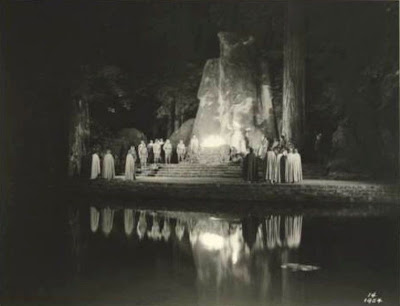
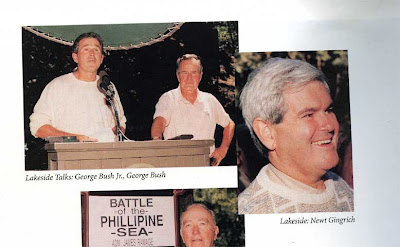
Various Grove photos found on the internet which provoke questions about these secret summer meetings. (click pics to enlarge):











Btw, have you ever heard of the Belizean Grove, a women's elite group started 10 yrs ago? Read more here: http://www.politico.com/news/stories/0609/23375.html
Here is the link to their website: http://belizeangrove.org/
1,200 vie for jobs at Bohemian Grove
By ROBERT DIGITALE
THE PRESS DEMOCRAT
Published: Saturday, June 13, 2009 at 3:00 a.m.
Last Modified: Saturday, June 13, 2009 at 10:32 p.m.
source
Along with local youth, summer job applicants at the exclusive Bohemian Grove encampment near Monte Rio include an architect, a financial planner and a mortgage adviser. “It would have been unusual in the past to see people from those areas,” said Matt Oggero, general manager of the San Francisco-based men’s club. In a possible sign of the economic times, Oggero said the club has experienced a “moderate increase in adults” applying for a short-term job at its annual summer encampment for rich and powerful men.
Nonetheless, the number of older adults still remain in the minority. About 400 of the roughly 600 workers will be under 23 years of age, said Jennifer Robertson, the club’s human resources director. Many of the older workers are educators on summer break, homemakers and retirees. The club has received about 1,200 applications this year, the first time in which potential workers could apply online. The numbers of applicants appear higher than last year.
The club’s 2,500 members will gather July 9-26 for the private annual encampment at the 2,700-acre retreat in the redwoods near the Russian River. In past years, the grove’s members and guests have included former U.S. presidents, business leaders and entertainers. The encampment, which has been held there for 120 years, at times has drawn protesters seeking to draw attention to the private gathering of shakers and movers. But for more than three decades, the grove also has been a major employer for high school and college students, perhaps second only to the Sonoma County Fair.
This year’s encampment will happen in a summer when local youth may have to hustle more to find work. “It’s definitely tough, but there still are jobs out there,” said Karen Fies, director of Sonoma County’s Workforce Investment Board. At the grove, the starting wage is about $10 an hour, with higher pay for some jobs and for those who previously have worked there. About 200 workers will return this year. “In many cases they’ll work their high school years and even college years,” Robertson said. The jobs, available to men and women, include baggage handling, valet parking, commissary work and serving as waiters and assistants in the main dining area.
A small number of workers started employment during the club’s Spring Jinks gathering in late May and will stay on through the July encampment. Both Oggero and Robertson said the quality of the applicants each year is outstanding. “The majority of the people we interview we end up hiring,” Robertson said. In recent years, an annual talent show has been staged by grove employees for their fellow workers. One year a club member took time to watch the show and later asked to hand out the award to the winning group. “It was Jimmy Buffett,” Oggero said. He recalled that “the kids just went nuts,” and the entertainer went on to serenade them with “Margaritaville.”
You can reach Staff Writer Robert Digitale at 521-5285 or robert.digitale@pressdemocrat.com.
--- end ---
Here's the craigslist ad to work at BG: http://sfbay.craigslist.org/nby/fbh/1179362268.html
And here are the jobs for BG: http://bcjobs.iapplicants.com/searchjobs.php
Various Grove photos found on the internet which provoke questions about these secret summer meetings. (click pics to enlarge):

Btw, have you ever heard of the Belizean Grove, a women's elite group started 10 yrs ago? Read more here: http://www.politico.com/news/stories/0609/23375.html
Here is the link to their website: http://belizeangrove.org/
Friday, June 12, 2009
From Rosalind Peterson June 12, 2009 RE: U.S. Navy Petitions to Washington, D.C.
June 12, 2009
To Whom It May Concern:
Please let everyone know that the delegation from Connecticut and California (Rosalind & Meredith Smith), spent this past week lobbying the U.S. Congress to defeat the U.S. Navy plan to harm marine mammals, other aquatic life and animals, along with negative impacts on human health, air and water.
We all arrived in Washington, D.C. armed with petitions from Washington, Oregon, Idaho, California and also from other states in the United States. We hand delivered petitions to California Senators Boxer and Feinstein, and Senator Ron Wyden from Oregon. In addition, Meredith Smith is staying in Washington, D.C., this coming week to lobby against the Navy.
Meredith arranged to meet at 4:00 P.M. with California Congressman Mike Thompson on Thursday, June 11th, to discuss what plans could be worked out to have Congressman Thompson work with us on congressional hearings into the Navy program. Meredith presented Congressman Thompson with a second binder containing all the petitions that we have gathered since we gave Thompson's aide, Heidi Dickerson, the first binder containing all of the original signatures gathered prior to the time that KTVU filmed the event in Fort Bragg, CA last month. Meredith was also going to let Congressman Thompson know about the binder presented to Heidi Dickerson last month since he did not seem to know that the public had presented his office with this binder full of petitions from all over California.
Today and during her stay in Washington, DC next week Meredith will be meeting with additional members of Congress and will be hand delivering our petitions to the Speaker of the House, Nancy Pelosi. Her efforts on behalf of the citizens of Mendocino County are to be highly commended. When she returns she will be reporting on the success of her efforts in Washington, D.C.
While the delegation was in Washington, D.C. this week we brought color brochures, packets, and information about the Navy Warfare expansion to every member of the U.S. Senate. In addition, we visited the offices of over 300 U.S. Congressmen with regard to this issue. There were many that did not know about this Navy plan and many expressed interest in learning more about it. Our elected officials seemed surprised that the Navy plan involved, as Congressmen Thompson and Waxman had stated in their letter, both the Atlantic and Pacific Oceans, the regions around the Marinas Islands, the Hawaiian Islands, the gulf of both Alaska and Mexico, and the Pacific Ocean from California to Oregon.
It should be noted that our elected officials were surprised that the petitions we collected were from real people and not just from anonymous people on the Internet. One staff member was completely surprised by this information.
Meredith Smith, owner of the Mendocino Cafe, should be commended for her efforts both this week and next week in bringing this information to the attention of our elected officials. It is now time for all of us to follow through with calls to our elected officials in Washington, D.C., over the next three months at their toll free number (1 866) 220-0044 to let them know that we are going to continue to speak out, collect signatures on petitions, and work toward congressional hearings to protect public health and our marine mammals.
Your continued work on this project - writing letters, gathering signatures which will be presented again to our elected officials (hand delivered), telephone calls, letters to the editor will all have a positive effect. Thank you again for all of your efforts and work on this project. If we work together we can initiate change and end this Navy Warfare expansion project.
Respectfully,
Rosalind Peterson
Post Office Box 499
Redwood Valley, CA 95470
(707) 485-7520
E-Mail: info@californiaskywatch.com
Website: californiaskywatch.com
More information: http://newswithviews.com/Peterson/rosalindA.htm
To Whom It May Concern:
Please let everyone know that the delegation from Connecticut and California (Rosalind & Meredith Smith), spent this past week lobbying the U.S. Congress to defeat the U.S. Navy plan to harm marine mammals, other aquatic life and animals, along with negative impacts on human health, air and water.
We all arrived in Washington, D.C. armed with petitions from Washington, Oregon, Idaho, California and also from other states in the United States. We hand delivered petitions to California Senators Boxer and Feinstein, and Senator Ron Wyden from Oregon. In addition, Meredith Smith is staying in Washington, D.C., this coming week to lobby against the Navy.
Meredith arranged to meet at 4:00 P.M. with California Congressman Mike Thompson on Thursday, June 11th, to discuss what plans could be worked out to have Congressman Thompson work with us on congressional hearings into the Navy program. Meredith presented Congressman Thompson with a second binder containing all the petitions that we have gathered since we gave Thompson's aide, Heidi Dickerson, the first binder containing all of the original signatures gathered prior to the time that KTVU filmed the event in Fort Bragg, CA last month. Meredith was also going to let Congressman Thompson know about the binder presented to Heidi Dickerson last month since he did not seem to know that the public had presented his office with this binder full of petitions from all over California.
Today and during her stay in Washington, DC next week Meredith will be meeting with additional members of Congress and will be hand delivering our petitions to the Speaker of the House, Nancy Pelosi. Her efforts on behalf of the citizens of Mendocino County are to be highly commended. When she returns she will be reporting on the success of her efforts in Washington, D.C.
While the delegation was in Washington, D.C. this week we brought color brochures, packets, and information about the Navy Warfare expansion to every member of the U.S. Senate. In addition, we visited the offices of over 300 U.S. Congressmen with regard to this issue. There were many that did not know about this Navy plan and many expressed interest in learning more about it. Our elected officials seemed surprised that the Navy plan involved, as Congressmen Thompson and Waxman had stated in their letter, both the Atlantic and Pacific Oceans, the regions around the Marinas Islands, the Hawaiian Islands, the gulf of both Alaska and Mexico, and the Pacific Ocean from California to Oregon.
It should be noted that our elected officials were surprised that the petitions we collected were from real people and not just from anonymous people on the Internet. One staff member was completely surprised by this information.
Meredith Smith, owner of the Mendocino Cafe, should be commended for her efforts both this week and next week in bringing this information to the attention of our elected officials. It is now time for all of us to follow through with calls to our elected officials in Washington, D.C., over the next three months at their toll free number (1 866) 220-0044 to let them know that we are going to continue to speak out, collect signatures on petitions, and work toward congressional hearings to protect public health and our marine mammals.
Your continued work on this project - writing letters, gathering signatures which will be presented again to our elected officials (hand delivered), telephone calls, letters to the editor will all have a positive effect. Thank you again for all of your efforts and work on this project. If we work together we can initiate change and end this Navy Warfare expansion project.
Respectfully,
Rosalind Peterson
Post Office Box 499
Redwood Valley, CA 95470
(707) 485-7520
E-Mail: info@californiaskywatch.com
Website: californiaskywatch.com
More information: http://newswithviews.com/Peterson/rosalindA.htm
Subscribe to:
Posts (Atom)
About Me

- Cathy Palmer
- Over the years my opinions have changed but this will never change: Jesus Christ, Lord, God and Savior, died on the cross and rose from the dead to pay for my sin.